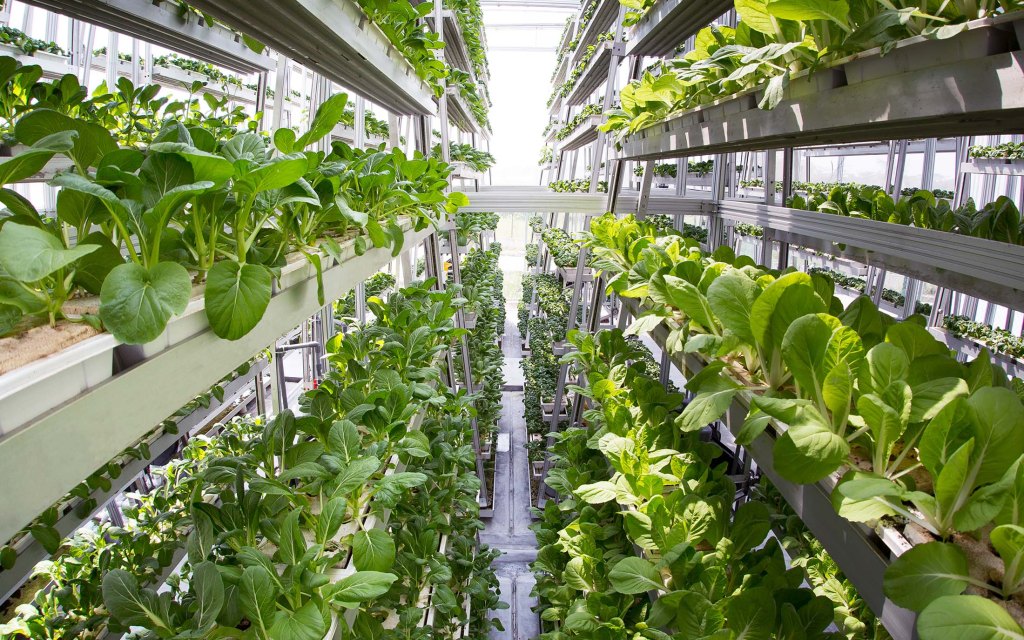
Agriculture is undoubtedly one of the biggest unresolved factors in the climate crisis: accounting for over 70% of global freshwater use¹ and a third of emissions in 2023³, it is a problem that remains largely unaddressed. Despite new farming philosophies like organic and regenerative, the vast majority of farming has remained relatively unchanged, compared to the seismic waves reverberating throughout the energy sector with the roll-out of renewable energy. As always, however, there is an outlier – vertical agriculture.
In essence, vertical farming utilises verticality to maximise production, with crops typically grown in stacked layers lacking soil. Evidently, there are advantages to this approach: not only does it require less land, but the use of artificial conditions via LED lighting facilitates growth all year round, leading to higher yields. Since the Babylonians first constructed the idea via their ‘hanging gardens’ in 600 BC, the idea has had many offshoots, including aeroponics, which grows crops via a nutrient-mist, without any substrate. Now in the 21st century, the concept is burgeoning into a futuristic industry, with the market size projected to reach $35.8bn by 2030², optimised for leafy vegetables like herbs and lettuces. However, for many, doubt lingers whether this new technology has the investment and versatility to eclipse land-intensive traditional agribusinesses.
Cleaner, Greener and Cheaper?
Primarily, the upsides of vertical farming revolve around yields – optimised, consistent conditions enable a 10% increase in yields², allowing farms to produce 200-1000 tonnes per acre². Given that land conversion is the main source of emissions from agriculture, such a drastically improved land-to-yield ratio could slash farming emissions, giving the method an edge over other green solutions like organic, which ironically catalyses more land destruction due to a need to increase lowered production resulting from organic policies like no pesticide usage. Vertical farming circumvents this problem entirely because, well, there are fewer pests to wrestle with indoors – pesticide costs are cut by 80%². Moreover, water use is significantly more efficient than that in field farming – hydroponic systems utilised by vertical farms are closed systems devoid of runoff or evaporation, constantly recirculating water, avoiding wastage. In fact, the gap in water efficiency is so huge, that the method is projected to save one trillion litres of water by 2030². And as if the advantages were not already significant enough, transportational costs are half that of traditional farms². As vertical farms don’t rely on swathes of land, they can be set up in cities, grouping producer and consumer in the same area, avoiding costly warehousing and storage.
Teething Problems
As with anything, unfortunately, downsides do exist. With such heralded efficiency, reliant upon many an artificial light and water pump, comes a large energy bill – one that is a quarter larger, on average. Such dependence on power comes with other negatives, besides just cost, including chronic vulnerability to power cuts, which can massacre a harvest in a matter of hours, and also additional emissions depending on the source of the electricity, which perhaps could offset the CO₂ savings of its efficiency, even if 30% of vertical farms use fully renewable power². As is to be expected from high-tech innovation, start-up costs for these farms are another negative, taking a momentous 6 years on average to reach a return on initial investment²: this is why, for many, switching to this hailed method is an impossibility, making it inaccessible for a multitude of the farming population.
Opinion – Make the Leap
Ultimately, vertical farming represents an unparalleled opportunity – unlike other climate change solutions that rely on compromising productivity to lower the impact on the planet, it combines what is still thought by many to be contradictory – sustainability and efficiency. It may have its drawbacks of its own, but on the whole, these problems are largely a diagnosis of external problems, like costly energy prices and a yet still fossil-fuelled energy mix, as well as its youth – as we have seen with solar and wind power, once investment gains traction, technology and start-up costs should tumble. Uniquely, agriculture is perhaps the last major industry that functions recognisably to how it did a century, two centuries, even three centuries ago – chemical wonders and machinery have come and gone, but core processes and appearance remain unchanged. For many, from environmentalists to scientists, it is time for one of the most strained industries to dare a change the likes of we have not seen since the mechanisation of the Industrial Revolution.
Citations and Sources
Gleick,P.H et al. (2014). The World’s Water: The Biennial Report on Freshwater Resources. Washington, DC: Island Press. [1]
Suki Patel. “Vertical Farming Industry Statistics.” Worldmetrics, February 12, 2026, https://worldmetrics.org/vertical-farming-industry-statistics/. [2]
Food and Agriculture Organisation of the United Nations (FAO) – Greenhouse gas emissions from agrifood systems. Global, regional and country trends, 2001-2023 – https://www.fao.org/statistics/highlights-archive/highlights-detail/greenhouse-gas-emissions-from-agrifood-systems.-global–regional-and-country-trends–2001-2023/en [3]
Image: Sky Urban Vertical Farming System ©

Leave a Reply